The Oyster Perpetual has always relied on a small number of familiar elements: a smooth bezel, three central hands, clear hour markers and an Oyster bracelet. That simplicity makes the new gold versions more interesting than their specifications initially suggest. Changing the metal alters the colour, weight and reflections of the whole watch, yet the design still has to retain the restraint associated with the collection.
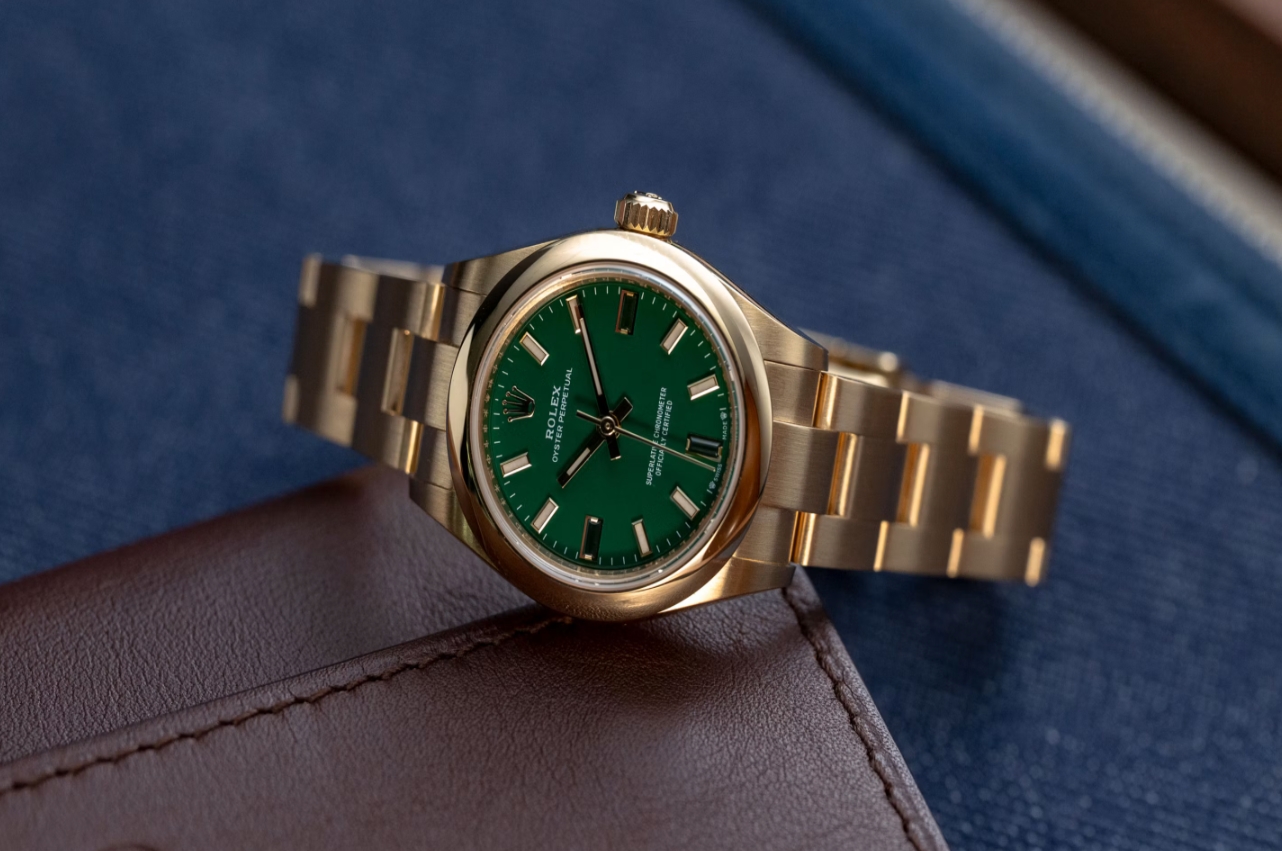
Rolex introduced the 34 mm reference 124205 in Everose gold and the 28 mm reference 276208 in yellow gold for the centenary of the Oyster in 2026. The launch examples paired the larger case with a blue stone lacquer dial and the smaller case with a green stone lacquer dial. Both used natural stone hour markers at three, six and nine o’clock, bringing texture to a dial that would otherwise remain extremely simple.
For readers comparing Rolex replica watches, the important point is not merely that these models look more expensive than the familiar steel Oyster Perpetual. Their character depends on the relationship between a predominantly satin-finished gold case and bracelet, a polished domed bezel and a glossy lacquer dial. If any one of those surfaces is handled incorrectly, the watch can become much louder and less balanced than the genuine design.
A thoughtful assessment of a Rolex Oyster Perpetual gold replica should therefore begin with visible proportions and finishing. Photographs can help establish colour, brushing direction, dial alignment and bracelet fit. They cannot confirm that a case is solid 18 ct gold, that a particular movement is installed or that the watch has passed a water-resistance test. Those claims require separate evidence.
The 34 mm and 28 mm Models Have Different Personalities
The two references share the same basic Oyster Perpetual layout, but the six-millimetre difference in diameter changes how that layout is read. The 34 mm version leaves more open space around the hands and markers. Its Everose colour also creates a softer transition into the blue dial than bright yellow gold would. The result is compact without looking miniature, which makes the case, bezel and bracelet proportions especially important on a replica.
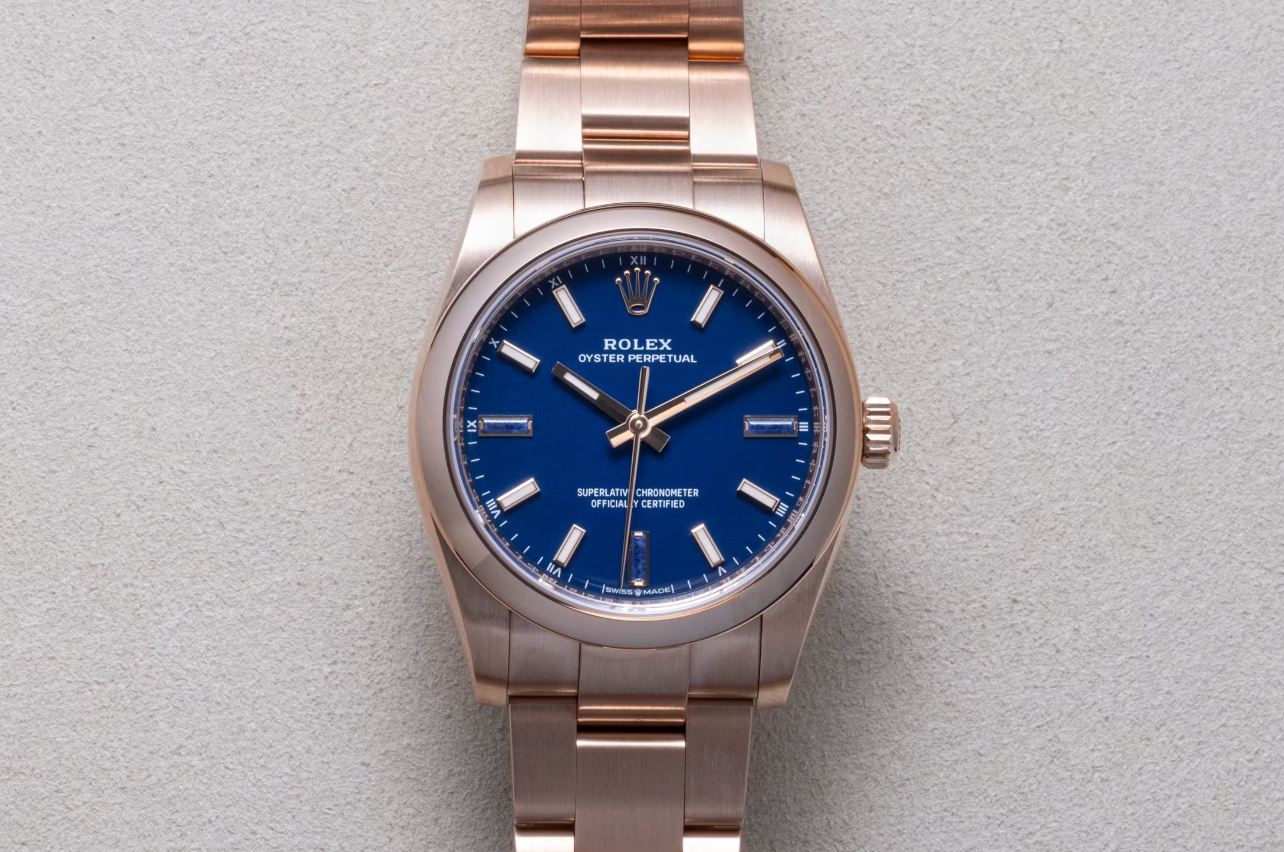
When examining a Rolex Oyster Perpetual 34mm replica, look beyond the stated diameter. The width of the domed bezel controls the apparent size of the dial, while the lug length determines how much wrist space the watch occupies. An oversized dial opening can make the bezel look weak. Thick lugs or end links that sit too low can make a modest case appear heavier than it should. A straight photograph and a side view are both needed to understand the full shape.
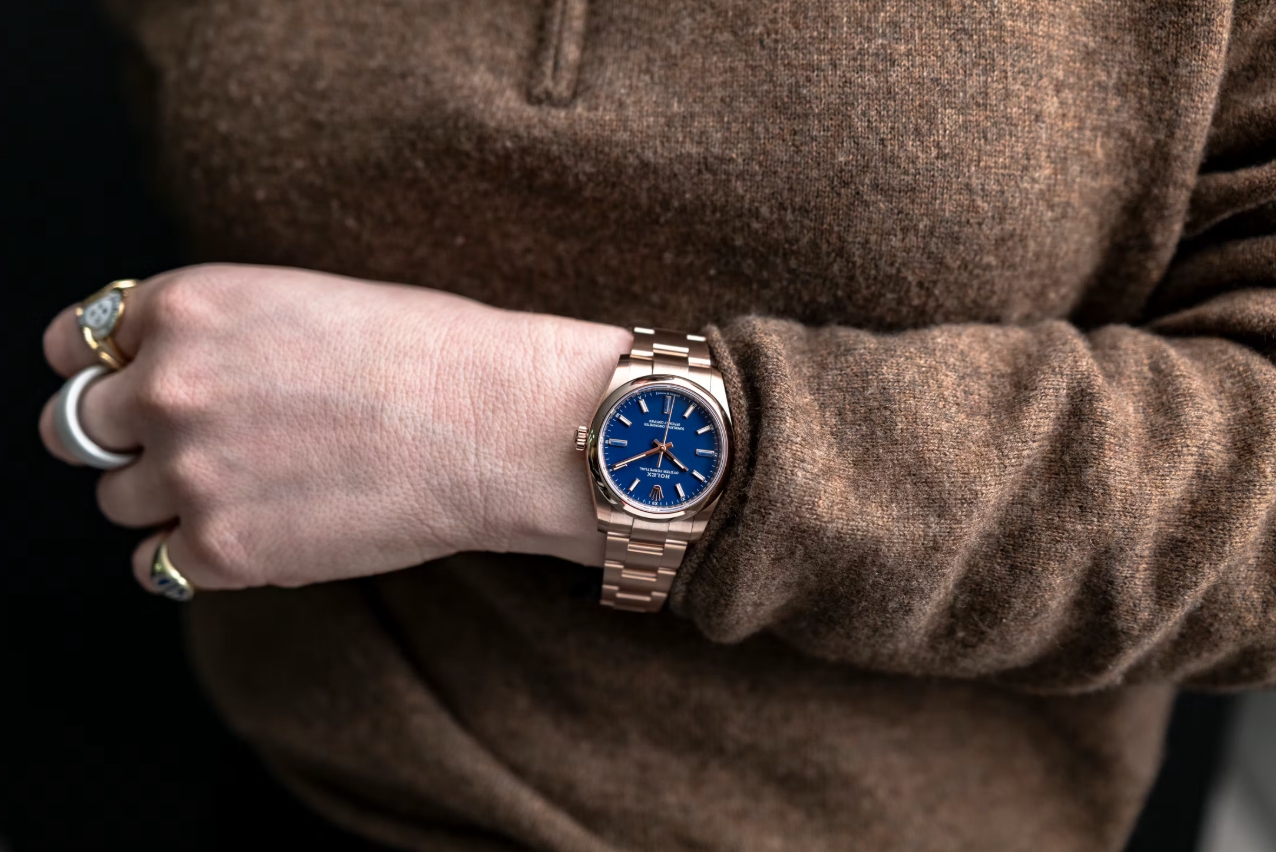
The 28 mm reference is more concentrated. Its yellow-gold case surrounds a smaller dial, so the hands, markers and coronet occupy a greater share of the available surface. Small errors become easier to notice because the printing and applied components sit closer together. The watch should still feel clear rather than crowded.
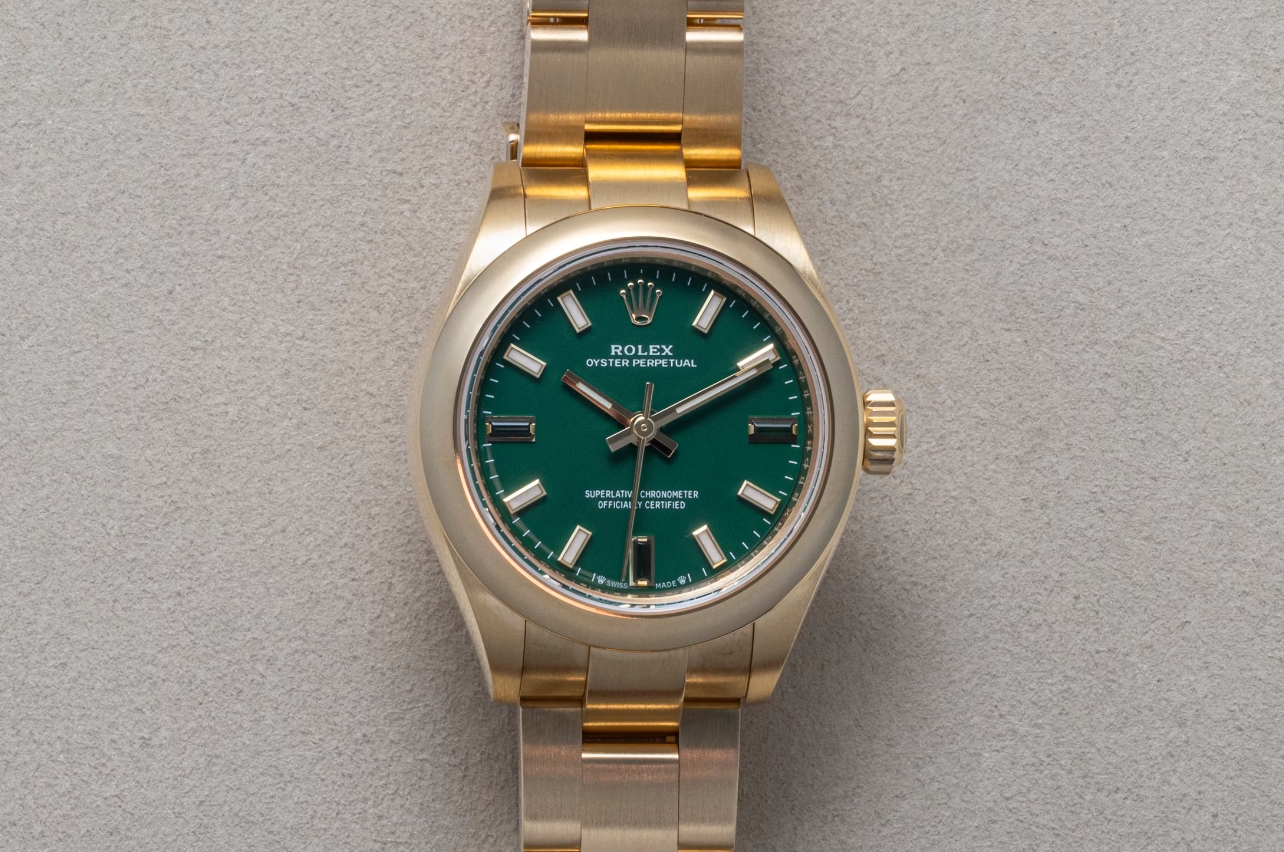
A Rolex Oyster Perpetual 28mm replica is best judged from a close, undistorted front image followed by a normal wrist photograph. Macro photography can make a small watch appear much larger and can exaggerate tiny finishing marks. The wrist view explains whether the case and bracelet retain the compact character that separates the 28 mm model from the 34 mm version.
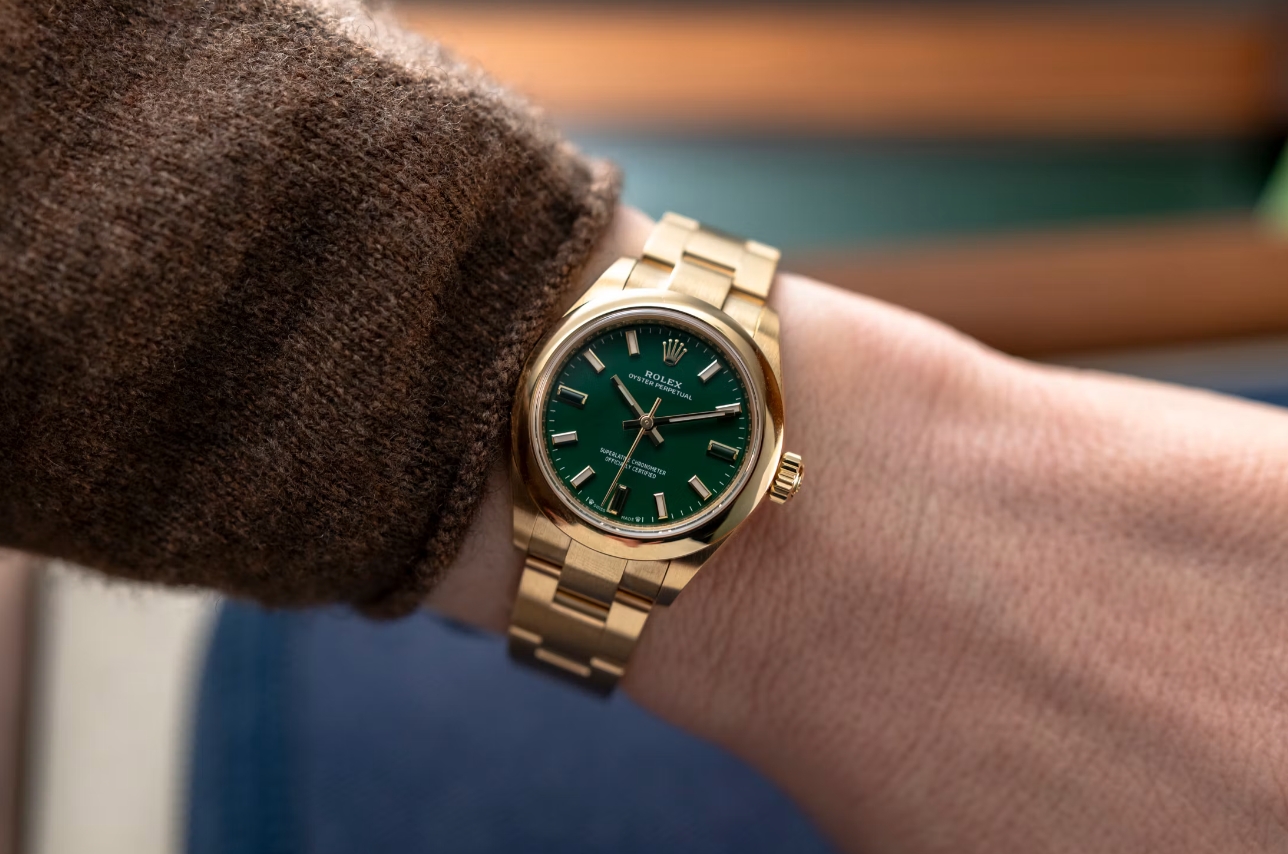
The launch dials add another layer of difficulty. On the genuine blue 34 mm configuration, dumortierite is used at three, six and nine o’clock. The green 28 mm configuration uses heliotrope in the same positions. Natural stone varies in colour and pattern, so the markers are not supposed to look like three identical pieces of printed material. Their cut, alignment and surface texture should remain consistent enough to work as a set while retaining some natural variation.
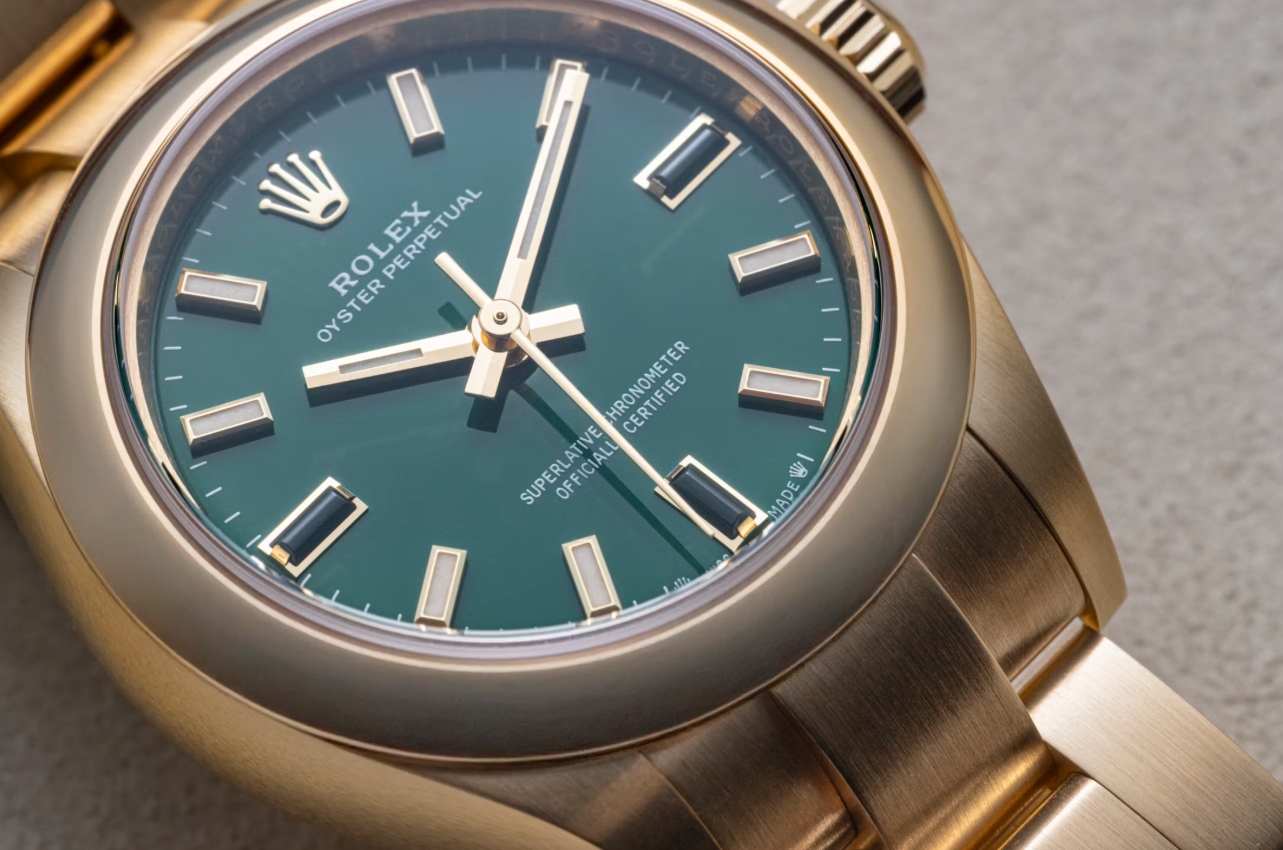
Replica descriptions should be precise about what is being reproduced. Coloured markers that resemble stone are not evidence that natural dumortierite or heliotrope has been used. A useful listing should identify the actual marker material and provide close photographs taken without aggressive colour enhancement. This is particularly relevant to gold Oyster Perpetual replica dial details, because saturated editing can make an ordinary blue or green coating appear deeper and more textured than it is.
The hour markers that are not made from stone carry luminous material on the genuine models. Their surrounds should have even edges, and the luminous filling should sit cleanly inside each marker. The hands need to correspond in colour with the surrounding metal while remaining distinct against the dial. Check the length of the minute hand, the centring of the coronet and the spacing of the printed text. On such a simple dial, small alignment errors affect the entire face.
Reference numbers also need context. The 124205 and 276208 are available with more than one dial, so the reference alone does not prove that a watch should have the blue or green launch configuration. A black, brown, turquoise or mother-of-pearl dial may belong to the same broader gold reference family, depending on the size and configuration. The article and image ALT text should describe the dial actually shown rather than treating one colour as the only version of the reference.
Gold Colour Surface Finish and Bracelet Fit
The most distinctive part of these watches is the way Rolex treats the precious metal. The main surfaces of the genuine case and bracelet are satin finished, while the domed bezel is polished. That contrast keeps the watch from becoming a single uninterrupted field of shine. The bezel catches direct light around the dial, while the brushed case and bracelet reflect light more softly.
This contrast should be examined under more than one lighting condition. A replica can look convincing in warm studio light but turn noticeably orange, pink or pale in daylight. Everose and yellow gold should also remain distinct from each other. The 34 mm model needs the warmer pink tone associated with Everose, while the 28 mm version should read as yellow gold without a green cast or an excessively bright plated appearance.
Look closely at the borders between finishes. The top of the lugs and the broad bracelet links should show an even grain, while the polished bezel should have a clean reflective edge. Brushing that runs in several directions or fades near the case can make the watch look roughly refinished. A material description such as plated steel, wrapped gold or solid gold should be supported by specific information rather than inferred from colour.
The Oyster bracelet is central to both references. On the genuine watches it uses broad three-piece links, an Oysterclasp and an Easylink comfort extension. The gold versions also use internal ceramic inserts around the bracelet pins to reduce wear. A replica bracelet may imitate the external shape without using the same internal construction, so photographs of the open clasp and link sides are more useful than a front view alone.
Good Rolex Oyster Perpetual replica bracelet proportions require a clean meeting point between the end links and case, a natural taper toward the clasp and enough articulation for the bracelet to curve around the wrist. This matters even more on the 28 mm version, where an oversized clasp or heavy end links can dominate the smaller case. On the 34 mm model, the bracelet should support the watch without making it look wider than the dial and bezel combination allows.
The movement needs similar care in the description. Rolex equips the genuine 28 mm and 34 mm models with calibre 2232, a self-winding movement with an approximate 55-hour power reserve. That specification establishes the original design; it does not identify the mechanism inside a replica. A seller or reviewer should give the actual movement name, a measured running time and timing results for the watch being discussed. The closed case back means that an unrelated movement image proves very little.
Rolex also rates the genuine watches to 100 metres and equips them with a Twinlock screw-down crown. A replica should not inherit that rating from its appearance. If water resistance matters, the individual watch needs a pressure test. The same principle applies to metal content and overall weight: measurements and documentation carry more value than descriptive labels.
Readers can compare other sizes, dial colours and case materials in our Rolex Oyster Perpetual replica watches section. These gold 34 mm and 28 mm references deserve their own place within that collection because their interest comes from finish and proportion rather than extra functions.
The strongest replica interpretation will preserve that restraint. The gold colour should remain believable in different light, the satin surfaces should contrast with the polished bezel and the stone-style markers should be accurately identified. The 34 mm watch needs enough openness around its dial, while the 28 mm model needs precision in a much tighter space. Those details explain the design far better than simply calling either watch a solid-gold Oyster Perpetual.